|
|
Carnatica's Paddhati Festival Highlights of Day 2 |
|
TNS - The Master Entertainer
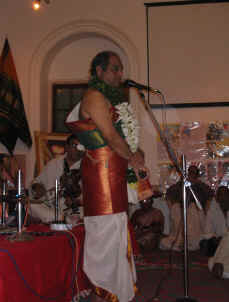
Sulakshana Gana Vichakshana Isai Perairgnar Madurai Sri. T. N. Seshagopalan, in traditional regalia presents a Harikatha, Gayasikhamani Charitram on the life and times of Harikesanallur Muthiah Bhagavatar
The main event of Day 2 was a Harikatha performance by Madurai T. N. Seshagopalan, on the life and times of Muthiah Bhagavatar. Dressed in traditional attire, TNS did a masterful job with eloquent and humorous descriptions punctuated by scintillating music. TNS' voice was in fine form and he left the listeners awestruck with his mastery over the subject. He was accompanied by VV Ravi (Violin), B. Ganapathyraman (Mridangam) and Kothandaraman (Harmonium) and had vocal support from his disciples. Earlier in the day there was an audio-visual presentation on Vidwan T. K. Rangachari. This was followed by a masterly and scholarly thematic concert on Varnams by veteran musician & musicologist, Prof. S. R. Janakiraman, the highlight of which were:
There was also a lecture by Dr. V. V. Srivatsa
on "Lyrical ornamentations in Trinity Compositions. He
presented interesting points on lyrical ornamentations in the trinity
compositions. He brought it out with many examples of songs composed by
them.
“Carnatic music comprises of Bhava, Raga and Tala and Bharata Sangeetha is only where bh is for bhava ra is for raga and ta for tala. In Carnatic music lakshana and lakshya have to come into common focus. Violation from either side creates complications . Focus on one point is important. Bhava is one of the prime factors constrained by the lyrical content the sahitya. It is this which limits and facilitates one distinctive feature Rasanubhava. Composition is mainly to create an atmosphere or let the listener have feelings of a particular rasa and that is where a group of compositions which are ‘shringara’ oriented like the padams and the javalis come. Lyrics can have 1. padha bava 2. Artha bhava 3.yati , prasa and anuprasa and 4. rasanubhava. Padha Bhava can be divided into 1.Use of words ---a. ancient and discontinued in course of time. b. Which have double meaning. 2. Coinage of new phrases.
Padha Bhava is basically using the right word at the right place. For eg. The word ‘gandharata’. Gandha means good smell and rata one who carries it (which is the wind). Muthuswamy dikshatar made use of it more than Thyagaraja. For eg. in the lines ‘navaneetha gandharvaha nagaram mrituvadanam’. A baby, which has stolen and eaten butter has a unique smell and ‘mridulata’. a sense of softness. This is carried across by the wind. Similarly the word is used in the panchabhuta keertana in raga Darbar. ‘Bhoo gandharvaha abhi’….. . Ancient word - ‘nyagroda’ is an ancient word for the banyan tree. Dikshatar has used it in the Devagupti keertana ‘Dakshinamurthi nyagromoolastithe’ … ( Dakshinamoorthi sitting under the banyan tree). Double meaning word: An example of double meaning can be seen in Thyagaraja’s ‘dasarathe dayasharate’. Here the word ‘dayasharate’ has the meaning of the ocean and also it means one who shows compassion ( Rama took the Brahmastra to destroy Samudra Raja, but when the latter relented and gave way he bestowed his grace). Coinage of new phrases: Ganesha was worshipped by Krishna say the puranas Rohini the mother of Balarama also worshipped Ganesha. A new concept can be given by developing a compound word. So ‘rowhineya ‘- (the son of Rohini i.e. Balarama), ‘rowhineyanuja; younger brother of rohini’s son i.e. Krishna) Artha BhavaNinda stuti where very critical view is given and the other is where a straight forward view is given. The Thyagaraja kriti in raga Shuba pantuvarali is an example of the former. Ennallu rakE yunduvojuthamu .. . YevaradikE vAru ledha srirama The line means “’how long are you going to be without saving me. Is there nobody to call you and put you in place?” A composition of Purandaradasa brings this factor well . Himavaan’s wife is called upon to describe Parvathi’s prospective bridegroom. The description says ‘ everybody will say a bridegroom looks like manmatha, but he (Shiva) has killed him; he has 4 heads with 3 eyes in each.; karalallu munda malae ( necklace of skulls); oragabhushana( snake as an ornament) manEgE smashAna ( cemetery for house);, gajacharmambara (wears herd of an elephant); his vehicle is a slow moving Nandi and he is the homer of boothas These lines are complete example of Ninda stuthi. But the last line ‘indrA ramana shree purandara vittalana (very dear to the heart of Indira’s husband called purandaravittala) negates all other negative factors narrated. It is a jugglery, a lucid presentation of words. Arha bhava has limitations. There is the straightforward approach for which Shyama Shastri is famous for. He says, “ taking care of me is difficult”. Here what he wishes to convey is said, i.e. hitting the nail on the head. The real decorative elements in a composition are Prasa, Anuprasa and Yathi. Prasa is a compulsion in Carnatic Music. The second akara of the pallavi and anupallavi must match. There may be exceptions like in Thyagaraja’s ‘Dasharatae’, the 2nd akshara in pallavi is sha and in anupallavi cha. These are not vargaksharas. The anubanda states that there is no compulsion for dwitiya akshara prasa in ya ra la va sha shha sa ha but only in ka cha ta tha pa ra. prasa should not only give audio satisfaction but also in terms of artha (meaning). Same akshara being used repetitively is also a type. The akshara delineates like ma, mA, mi ,mI. Eg. ‘Mandahasa vadani…mathanga kamimnI’. Anuprasa is difficult in Sanskrit than Telugu. Shyama shastri has surpassed in the use of upamana. he is the only composer to use the words like meru, sumeru, . prasa and anuprasa with single letter is easy but becomes difficult with compound words. The Ragamudra ornamentation has been highly and hundred percent handled by Muthuswami Dikshatar alone. In the lines ‘kamakalae vimalae karakamalae; kAmakoti bilahari nuta sakalae ( song- kamakshi varalkashmi)..The raga’s name Bilahari is used. Similarly in the lines ‘parimala ranganatham bhajae hamveeranuta’ ( raga hamveerkalyani). Shyama shastri has made rare uses like bhairavi in the keertanas in Bhairavi. Yatis are of two forms tapering ( saarasagaye…rasagaye..sagaye)and expansive yati like in the song Thyagaraja yoga vaibhavam ( svaprakasam..swaroopaprakasam..thatvaswaroopa prakasam…..). So ornamentation in compositions are of great value and are unique. |
|
|
Questions or comments? Send
us E-mail. |
|